Research through design/ design through research: looking for solutions to the scarred land left behind by open cut mining.
Monday, March 28, 2011
Wednesday, March 23, 2011
Landscape - painted
![]() |
| 6Days in Nelson & Canterbury by Colin McCahon, 1963 |
Monday, March 21, 2011
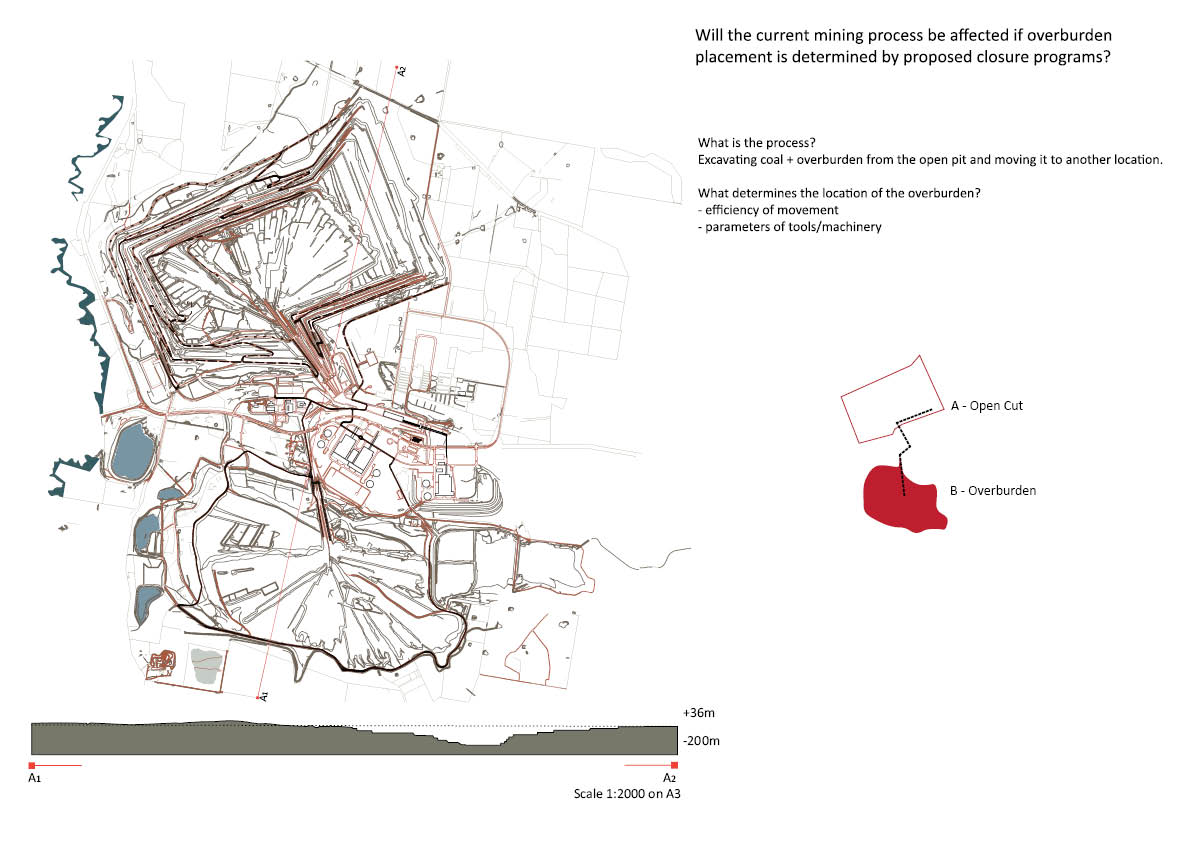
Will the current mining process be affected if overburden placement is determined by proposed closure programs?
From the follie-making process in relation to my design research I configured a hierarchy in the closure and reformation design proposals: Process - Formation - Program - Aesthetic.
The task set was to determine what happens to closure scenarios when:
1. Design how and where Overburden is going to be moved based on its end formation
2. Design how and where Overburden is going to be moved based on set closure programs
Will current mining processes be affected if closure scenarios are designed rather then continuing with the current practise.
I propose that they would, however how is not known.
It was difficult to propose form on a site that is so vast and has many different programs operating in it already. Processes, whether ecological or operational to the power plants, occur from the macro to the micro.
At which scale do I investigate in order to reach beyond the current programs?
I found that I was not designing but investigating constraints. Some of these design inhibitors included:
- The overlapping of different programs at one time
- Scale! View vs program vs human scale
- Looking at the whole landscape rather than segmenting into Open Cut, or Over-Burden, or Power Plant, or water bodies
- Volume of material being moved. How do I measure this?
- Closure scenarios are vague and propositions could include an extension to the open cut rather than closure
Also I had thoughts on what it was that I was trying to design?
Based on the hierarchy that I have set out: Process - Formation - Program - Aesthetic; the latter is the only one I was not directly trying to test. Through drawing, I felt that I was trying to achieve a particular aesthetic essence.
Is the aesthetic a product of the program/process or can it be designed as a key objective?
The project is very open right now. In order to start designing I need to determine ‘what is my site?’ and ‘what programs will closure enable?’. This should then allow scalable scenarios to be worked on.
The task set was to determine what happens to closure scenarios when:
1. Design how and where Overburden is going to be moved based on its end formation
2. Design how and where Overburden is going to be moved based on set closure programs
Will current mining processes be affected if closure scenarios are designed rather then continuing with the current practise.
I propose that they would, however how is not known.
It was difficult to propose form on a site that is so vast and has many different programs operating in it already. Processes, whether ecological or operational to the power plants, occur from the macro to the micro.
At which scale do I investigate in order to reach beyond the current programs?
I found that I was not designing but investigating constraints. Some of these design inhibitors included:
- The overlapping of different programs at one time
- Scale! View vs program vs human scale
- Looking at the whole landscape rather than segmenting into Open Cut, or Over-Burden, or Power Plant, or water bodies
- Volume of material being moved. How do I measure this?
- Closure scenarios are vague and propositions could include an extension to the open cut rather than closure
Also I had thoughts on what it was that I was trying to design?
Based on the hierarchy that I have set out: Process - Formation - Program - Aesthetic; the latter is the only one I was not directly trying to test. Through drawing, I felt that I was trying to achieve a particular aesthetic essence.
Is the aesthetic a product of the program/process or can it be designed as a key objective?
The project is very open right now. In order to start designing I need to determine ‘what is my site?’ and ‘what programs will closure enable?’. This should then allow scalable scenarios to be worked on.
Wednesday, March 16, 2011
Post Industrial Landscape
Are we drawn to a post-industrial landscape? Does it highlight the 'natural' surrounds?
Does it evoke us to explore or play?
Does the scale ground or heighten our sense of being?
I am not sure how I feel about the remnants of industry. It is foreign to the places I seek to be in, yet it is never too far from where I am. Perhaps all this time I have been trying to look past it rather than explore its design potential.
Here's some interesting projects I found.
![]() | |
| Conveyor bridge Lichterfeld-Schacksdorf http://www.iba-see2010.de/en/projekte/projekt3 |
![]() | ||
![]() |
| IBA Emscher Park - Slab for the Ruhl |
![]() |
| IBA - Welzow 'Landscape made from a giant's hand' |
![]() |
| Duisburg Nord Landscape Park |
Tuesday, March 15, 2011
Weekend workshop 11-13 March
The weekend was spent at a workshop camp in Anglesea on the Great Ocean Road. Time was spend considering the process and formation of mine overburden, through the act of making several follies. See below for further details of this exploration.
![]() ![]() |
| The act of making follies led to consideration of the heirachy of land reformation. |
| Just after sun rise outside the cabins |
| A little bug I found in the morning near the cabins |
Subscribe to:
Posts (Atom)


